
How to dispose of a sofa legally in the UK (with a paper trail)
A practical, fixed-price guide to getting a sofa removed compliantly - when you can donate or reuse it, when only a licensed carrier can take it, and why a duty-of-care receipt matters if you ever get asked where it went.
By Binshare Team
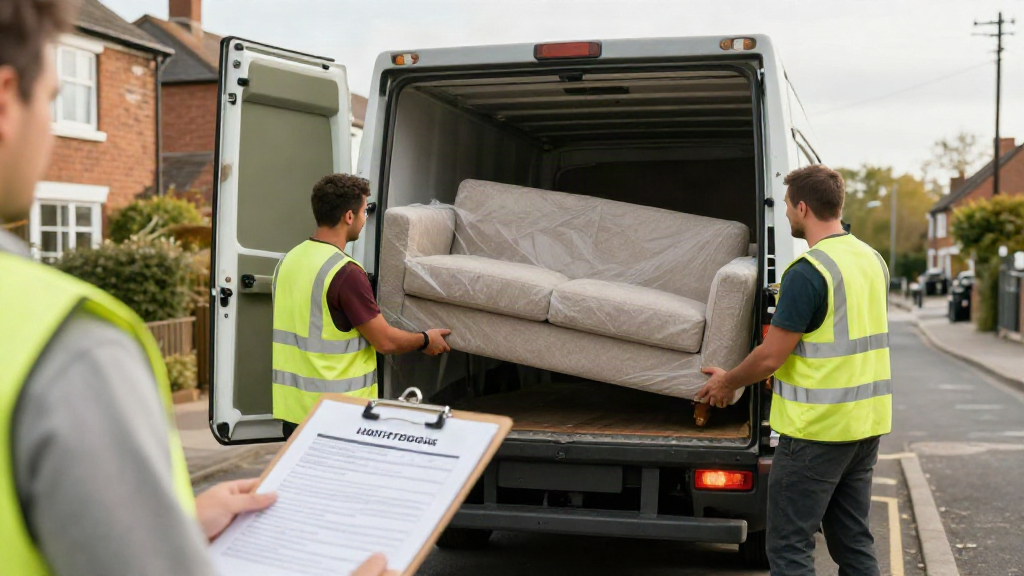
How to dispose of a sofa legally in the UK (with a paper trail)
A sofa is the sneakiest piece of furniture you'll ever get rid of. It's too big for the bin, too awkward for most friends to help with, and if it ends up dumped on a roadside, you're suddenly on the hook for a hefty fly-tipping fine.
The good news? Getting rid of a sofa the legal way is simple, and you should walk away with something most people never think to ask for: a paper trail.
Here's how to dispose of a sofa correctly in the UK, when you can reuse it, and why a duty-of-care receipt matters more than you'd think.
Rule one: can the sofa be reused?
Before any removal talk, ask yourself one question: is your sofa actually beyond saving? If it's in decent condition, recycling and reuse can save you money, cut waste, and often feel better than a skip.
Your options in order:
- Donate it. Charities like the British Heart Foundation collect sofas in good condition, provided they meet fire-safety standards and carry the correct permanent label.
- Sell or give it away. Facebook Marketplace, Gumtree and local free-cycle groups move sofas surprisingly fast. Just be honest about condition, wear and any smells.
- Book a reuse-focused collection. If you want someone else to sort it all out, an EA-licensed carrier that prioritises reuse can find a second life for your sofa before anything reaches a tip.
A sofa only becomes "waste" when no one will take it on. Until then, reuse is nearly always the cheaper, greener route.
When only a licensed waste carrier can take it
If your sofa is torn, stained, worn out, or just not worth passing on, then it's official waste. And once it's waste, the rules change.
Under UK waste law, anyone moving waste as part of a business must be a registered waste carrier. That includes the person who picks up your sofa. Check their registration with the Environment Agency (EA) before they load anything onto their van. It takes about thirty seconds, and it's the single best way to protect yourself.
Here's the key: if your sofa is collected and then dumped illegally, the fine and responsibility can follow the waste back to its owner. That can mean thousands of pounds in penalties for something you thought you'd simply "had taken away". Hiring an EA-licensed carrier is how you stop that from ever being your problem.
The duty-of-care receipt: your proof it's done right
This is the paper trail that makes everything else matter.
Every time your sofa waste changes hands, the person passing it on has a legal duty of care to make sure it's handled, stored and disposed of properly. That responsibility is transferred properly through a waste transfer note — in practice, for most homeowners, a simple duty-of-care receipt.
A proper duty-of-care receipt should tell you:
- who the collection was done by (the licensed carrier)
- what was collected (your sofa)
- the date it was collected
- where the waste was taken (the authorised disposal or recycling site)
Keep that receipt. It's your proof that your sofa went to a lawful destination. If anyone ever asks where it ended up, you hold the evidence.
The cost of skipping the process
Doing a sofa removal properly isn't just about paperwork. It's about not leaving yourself exposed.
Fly-tipping is an offence that carries fines of up to £50,000 (or up to five years in prison) in the most serious cases. Councils and the EA increasingly trace waste back to source. So when someone offers to take your sofa for cash, no paperwork, if they dump it in a country lane two miles away, the enforcement team may well find you first.
A fly-tipping penalty is a bad day to discover your "cheap" removal wasn't cheap after all.
How a fixed-price sofa removal works
If you want all of this handled for you, a compliant, fixed-price service keeps it simple. Here's roughly what to expect:
- Share what you're getting rid of. In most modern services you can snap a photo of your sofa and describe what it is.
- Get a fixed quote in advance. The price should be agreed before anyone turns up, with no surprises on the day.
- A licensed carrier confirms, collects, and handles the disposal.
- You receive your duty-of-care receipt as proof it was done lawfully.
From posting the details to having the job booked often takes about ninety seconds. After that, the carrier does the heavy lifting — literally.
With Binshare, the removal is handled by EA-licensed carriers only, so you're never relying on a random van. You get a fixed price up front, and your duty-of-care receipt arrives as part of the job. That's the peace of mind most removals leave out.
Your sofa disposal checklist
Before you book anything, run through this:
- Can the sofa be reused or donated? If yes, start there.
- Is the carrier an EA-licensed waste carrier? Always check.
- Do you have a fixed price agreed before collection? You should.
- Will you receive a duty-of-care receipt? If the answer is no, walk away.
The bottom line
Disposing of a sofa the legal way isn't complicated. Reuse it if you can, use a licensed carrier if you can't, and never accept a removal without a duty-of-care paper trail.
Get those three things right, and you've done your part to keep waste out of ditches — with a receipt to prove it.