WEEE disposal in the UK: how households and businesses comply
A comprehensive guide on how UK households and businesses can legally and safely dispose of Waste Electrical and Electronic Equipment (WEEE).
By Binshare Team
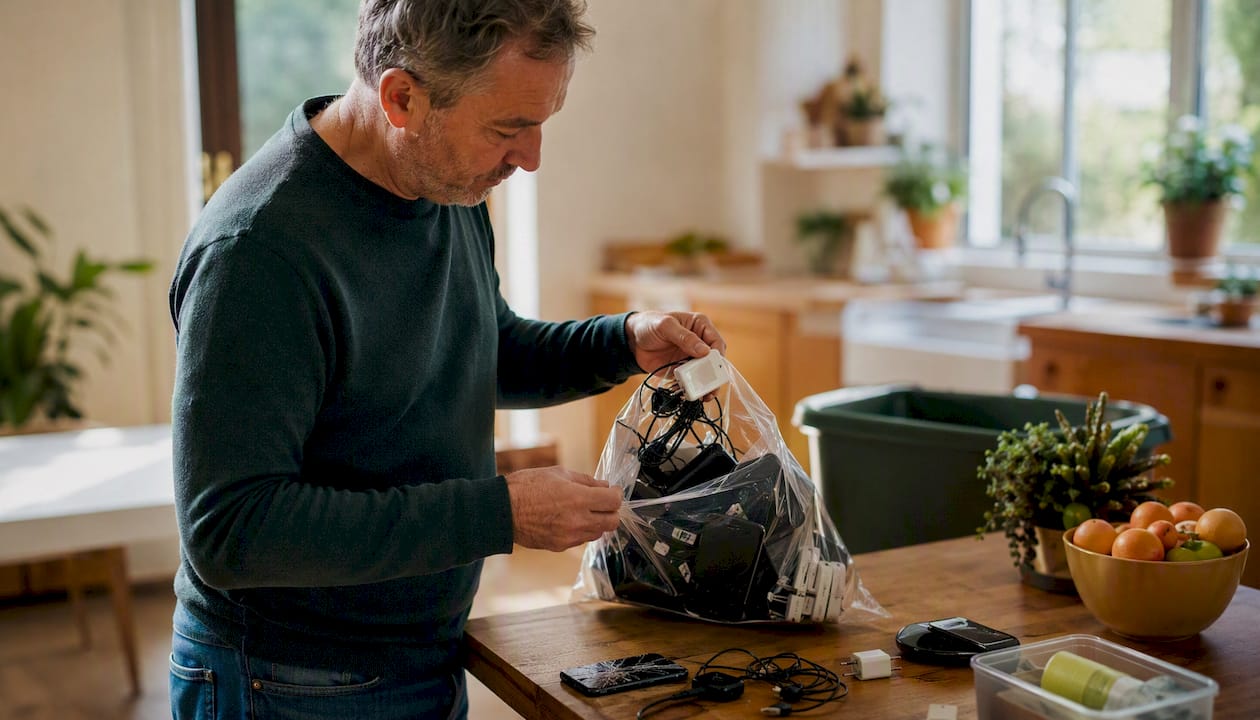
Every year the UK generates over 1.6 million tonnes of Waste Electrical and Electronic Equipment (WEEE), from broken kettles and dead vapes to enterprise servers and industrial machinery. Almost none of that should end up in a general-waste bin — yet a huge proportion still does, quietly leaching heavy metals into landfill and exposing households and businesses to fines they didn't know existed. This is a practical guide to disposing of WEEE properly in the UK, whether you're clearing out a single drawer of old phones at home or running a compliance programme for a hundred-site retailer.
1. What is WEEE?
WEEE — Waste Electrical and Electronic Equipment — is defined under the Waste Electrical and Electronic Equipment Regulations 2013 (SI 2013/3113) as anything that has a plug, uses a battery, or contains any electrical or electronic component and has reached the end of its useful life. The UK regulations transpose the EU WEEE Directive (2012/19/EU), and they still apply in Great Britain and Northern Ireland after Brexit under retained-EU-law rules.
In everyday terms, if it has a wire, a battery, or a circuit board — and you no longer want it — it's WEEE. That covers everything from a broken kettle to a decommissioned data-centre rack, plus a surprising long-tail of items people don't associate with electronics at all (smoke alarms, LED bulbs, single-use vapes).
2. Why proper WEEE disposal matters
Three reasons — environmental, legal, and personal.
- Environmental: WEEE contains hazardous substances including lead in solder and CRT glass, mercury in older lamps and switches, cadmium in some rechargeable batteries, and brominated flame retardants in plastic housings. Sent to landfill, these leach into soil and groundwater; incinerated, they release toxic fumes.
- Legal: Under the Environmental Protection Act 1990 and the WEEE Regulations, producers, distributors and end-users all carry duty-of-care obligations. Households can be issued fixed-penalty notices of up to £400 for improper disposal; businesses face unlimited fines in the Crown Court and can be prosecuted under the Environment Agency's enforcement powers.
- Data security: An old laptop or smartphone still holds photos, saved passwords, cached emails and browser history. Discarding it in a general skip is the single most common source of accidental data breaches for small businesses in the UK — and under UK GDPR, that breach is reportable to the ICO within 72 hours.
3. Household WEEE disposal — the five safe routes
For homeowners, none of these should cost you money. WEEE is one of the few waste streams where the law explicitly requires free take-back options for domestic users.
- Household Waste Recycling Centres (HWRCs): every local authority in the UK operates at least one HWRC (formerly called a 'tip' or 'civic amenity site') that accepts household WEEE free of charge. Search 'HWRC' plus your postcode — book a slot if your council requires it.
- Retailer take-back schemes: any retailer selling electricals is legally required to offer a way to take back your old equivalent item when you buy a new one. Larger retailers (500 m² of electricals or more) must accept small WEEE for free even without a purchase — this is the 1-for-1 rule.
- Kerbside WEEE collection: a growing number of councils (currently roughly a third) offer kerbside collection for small WEEE, usually in a special clear bag. Check your council's website for the schedule and accepted items.
- Charity donation for working items: if it still works, it isn't waste. Charities like SOFA Project, Reuse Network members, and British Heart Foundation refurbish and resell — and you get to feel briefly virtuous.
- Licensed WEEE carrier via Binshare: for bulky items (fridges, washing machines, TVs), or when you want the pickup done at your door with minimal effort, post the item on Binshare and licensed carriers will bid competitively to collect it — with proper WEEE documentation.
4. Business WEEE compliance
For businesses the compliance regime is significantly heavier — and it applies whether you produce ten IT laptops a year or ten thousand fridges.
- Producer responsibility: If you manufacture, rebrand or import electrical equipment into the UK you must register with the Environment Agency (or SEPA/NIEA), report placed-on-market tonnage, and pay towards the collection and treatment of your share of the national WEEE take-back obligation. Most producers meet this through a Producer Compliance Scheme (PCS) rather than registering directly.
- AATF requirements: WEEE from businesses must be treated at an Approved Authorised Treatment Facility (AATF). AATFs are licensed by the environmental regulator and are the only entities that can legally issue an Evidence Note proving your waste was treated compliantly.
- Compliance schemes: PCSs (e.g. Valpak, Comply Direct, Ecosurety) handle the reporting, financing and evidence-note collection on your behalf. Fees are based on the tonnage of equipment you place on the market.
- Duty of care: Under Section 34 of the Environmental Protection Act 1990, when you hand WEEE to any third party you must satisfy yourself they are appropriately licensed and issue a written waste transfer note (or the digital equivalent) covering every consignment.
- Record-keeping: All waste transfer notes must be retained for at least two years; hazardous WEEE consignment notes for three. Records must be produced on request by the Environment Agency, HMRC (for import producers), and — increasingly — by ESG auditors.
5. Comparing your options at a glance
| Method | Cost | Convenience | Best for |
|---|---|---|---|
| HWRC / council tip | Free (households) | You transport it yourself | One-off small items, when you've got a car and time |
| Retailer take-back | Free | In-store drop-off | Small items when you're already shopping for a replacement |
| Kerbside WEEE bag | Free where available | Zero effort — leave at kerb | Small items, if your council runs a scheme |
| Licensed carrier via Binshare | Competitive bids (typ. £25–£120) | Photo → bid → doorstep pickup | Bulky, multiple, or business items; anyone needing digital duty-of-care |
6. Common WEEE items people forget
A surprising amount of WEEE gets thrown into general waste because people don't recognise it as electrical. If you're clearing a house, an office, or a rental turnover, check for:
- Smoke and carbon-monoxide detectors — battery-powered ones especially
- Electric toothbrushes and shavers (integrated non-removable batteries make these especially hazardous)
- LED bulbs and light strips (contain circuitry and small amounts of soldered heavy metals)
- Disposable and refillable vapes / e-cigarettes — an estimated 5 million are binned in the UK every week
- Battery-powered children's toys and greeting cards
- Cables, chargers and power supplies (yes, on their own)
- Kitchen scales, thermometers, and any 'smart' cookware
- Old fitness trackers, wireless earbuds, Bluetooth speakers
7. How Binshare fits into your WEEE workflow
Binshare is a marketplace between waste producers and licensed carriers. For WEEE specifically, that means four practical benefits:
- Snap and post: photograph the item, add the postcode, mark the category as WEEE. It takes under 60 seconds.
- Competitive bids: only carriers that hold a valid Environment Agency waste-carrier licence — and, where relevant, are approved to move upper-tier waste — can bid on your job. You compare on price, timing, and reviews.
- Tracked and compliant: every completed job auto-generates a digital duty-of-care record and, where the receiving site is an AATF, links you to the Evidence Note reference. That's your proof of compliance in the event of an audit or ICO enquiry.
- Data-safe: for computers, phones and any device with storage, carriers can be filtered to those offering certified data destruction (WEEELABEX or ADISA equivalent).
Conclusion
Proper WEEE disposal isn't difficult — it just requires knowing which of the five routes suits the item in front of you, and (if you're a business) keeping the paperwork tidy. For anything bulky, sensitive, or that you'd rather someone else moved, Binshare turns the whole thing into a single photograph and a bid.
Post your WEEE on Binshare, pick a licensed carrier, and get compliant disposal without leaving the house.