
What is duty of care for waste? Your guide to legal rubbish removal in the UK
Explain what carrying waste responsibly means in the UK, why EA-licensed carriers and a duty-of-care receipt protect you from fly-tipping fines, and how Binshare guarantees a full compliance paper trail on every job.
By Binshare Team
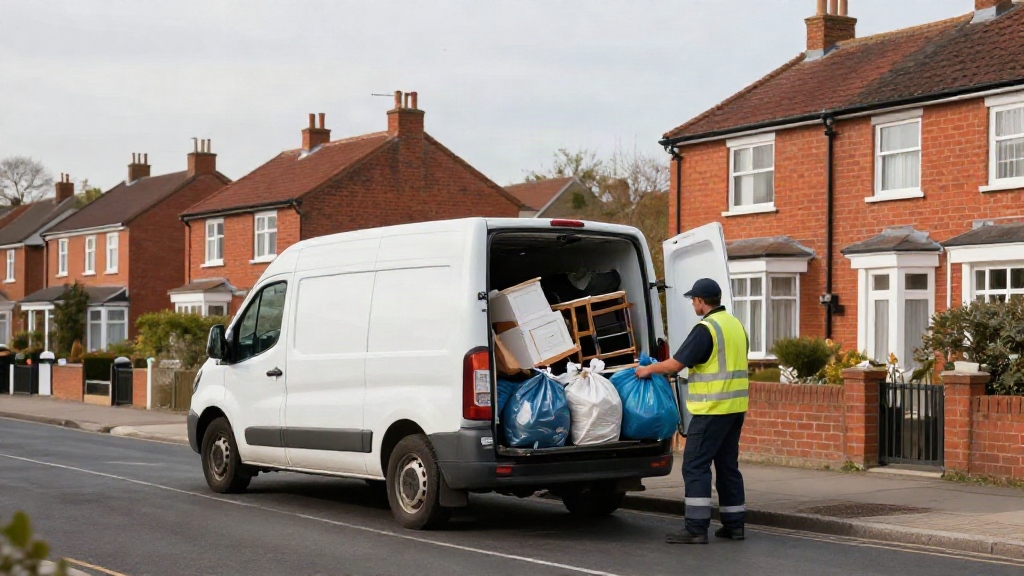
If you pay someone to take your rubbish away, the law does not stop caring about that rubbish the moment it leaves your driveway. Under the UK's duty of care for waste, you remain responsible for making sure it is passed to a properly authorised carrier and disposed of legally - and you have to be able to prove it. Get that wrong and the fine can land on you, not on the person who dumped it.
This guide answers the questions people ask most often before they book a clearance: what duty of care actually means, who it applies to, what paperwork protects you, and how Binshare makes the whole thing a paper trail instead of a gamble.
What is duty of care for waste?
Duty of care is a legal obligation set out in section 34 of the Environmental Protection Act 1990. It says that anyone who produces, carries, keeps, treats or disposes of controlled waste must take all reasonable steps to ensure the waste is handled correctly.
In plain English, that means:
- Waste is only transferred to an authorised person - someone with a waste carrier registration, and an environmental permit if they are storing or treating it.
- Waste is stored safely and securely, so it cannot escape or attract vermin before collection.
- The waste is transported to an authorised site, and it gets there.
- A written record of the transfer is kept, and kept for the right amount of time.
Controlled waste covers almost everything a household or business throws away: general rubbish, bulky items, garden waste, furniture, office furniture, packaging, WEEE (electricals), and construction or DIY waste. It does not cover things like septic tank sludge or radioactive waste, which are handled separately.
Who does duty of care apply to?
Just about everyone with waste in their possession.
- Householders are expected to take reasonable steps to check that whoever takes their waste is authorised to do so. Since 2018, householders in England can be fined if their waste is fly-tipped and traced back to them.
- Businesses - including shops, offices, landlords and trades - have the strictest obligations. They must keep written records for a minimum of two years, produce waste transfer notes on request, and check the registration of every carrier they use.
- Carriers and waste operators must be registered with the relevant environmental regulator, keep their own records, and make sure the tipping site is permitted.
If you run a business and can't show a waste transfer note for a collection, you can be fined even if the waste was handled perfectly.
What is a waste transfer note?
A waste transfer note (WTN) is the written record of waste changing hands. It needs to describe the waste, state how much there is and how it is contained, name the parties involved, and be signed by both sides. For recurring collections of the same waste type, a season ticket allows one note to cover up to twelve months.
You must keep waste transfer notes for two years. That note is the document a council or regulator will ask for if there is ever a question about where your waste went.
What is a duty-of-care receipt, and why does it matter?
A duty-of-care receipt is the customer-facing record that shows the job happened legally: who collected your waste, on what date, what was taken, and where it was delivered for disposal, recycling or reuse. It is the paper trail behind a waste transfer note, and it is what turns "trust me" into proof.
That proof matters in three ways:
- It shows you took reasonable steps, which is exactly what duty of care requires of you.
- It protects you from liability if the waste is later found fly-tipped somewhere it shouldn't be.
- It is a legal requirement for businesses, and good practice for households.
How do you check a waste carrier is legitimate?
Ask for their waste carrier registration number and check it against the public register held by the Environment Agency (in England), Natural Resources Wales, SEPA in Scotland or NIEA in Northern Ireland. It takes about a minute and it is free.
Then do three more checks:
- Ask where the waste is going, and get the address of the receiving site.
- Ask for the paperwork - a transfer note or duty-of-care receipt - before or immediately after collection.
- Be suspicious of anyone who quotes a price far below everyone else, offers cash-only "no questions" deals, or turns up unmarked without a registration number.
Rogue traders undercut legal operators because they skip the tip fees - and if they fly-tip your waste, that undercutting becomes your problem.
Why the £500 Flytipping Guarantee changes the maths
Every carrier on Binshare is an EA-licensed waste operator, and they are held to that standard on every job. If waste booked through Binshare is ever found to have been fly-tipped, Binshare covers the fine up to £500.
That is what a compliance-first marketplace is for. You don't have to verify a registration number, argue about where the waste is going, or chase paperwork. You snap a photo, get fixed quotes from licensed local carriers, choose one, and receive your duty-of-care receipt once the job is done - usually in about ninety seconds from photo to quote.
Frequently asked questions
Can I be fined if I didn't dump the waste myself? Yes. Householders in England can be fined up to £400 under the household waste duty of care rules if their waste is fly-tipped and traced back to them, and businesses face far larger penalties. Using an authorised carrier and keeping the receipt is how you discharge your duty of care.
How long do I keep waste paperwork? Householders should keep duty-of-care receipts for at least two years. Businesses must keep waste transfer notes for two years as well, and businesses that are registered waste producers should keep the records available for inspection.
Does duty of care apply to garden waste and bulky items? Yes. Garden waste, furniture, mattresses, white goods and DIY waste are all controlled waste, and the same rules apply whether it's a single wardrobe or a full house clearance.
What if I use a man and van for a house clearance? The van operator still needs a waste carrier registration if they are removing waste - the exemption that used to cover some waste carriers was withdrawn in 2013. Ask for the registration number before you book, and expect a duty-of-care receipt afterwards.
Do I need a transfer note for a one-off house clearance? Yes. A single collection still means waste changed hands, so you should receive a written record. With Binshare, that's your duty-of-care receipt, issued on completion of the job.
Is fly-tipping a criminal offence? Yes. Fly-tipping carries an unlimited fine and up to five years in prison for the most serious cases, and local authorities issue fixed penalty notices for smaller offences. That is precisely why the paper trail protecting the customer matters.
The short version
Duty of care for waste is simple in principle: know who is taking your waste, know they are authorised, and keep the proof. Do that and you're protected. Skip it and the fine follows the waste back to you.
Binshare exists to make that easy - licensed carriers only, fixed prices, and a duty-of-care receipt on every job, backed by the £500 Flytipping Guarantee. Reuse. Remove. Clear. Snap a photo and get fixed quotes from verified local carriers in about ninety seconds.